The Psychology Behind Menu Prices: How Restaurants Can Use Pricing Strategies to Increase Profit
Connexup Team
Sep 11, 2026
For many restaurant operators, menu pricing may seem like a straightforward process. Calculate ingredient costs, labor expenses, operational costs, add a target profit margin, and set the final selling price.
For years, many restaurants have relied on a simple cost-based pricing approach — often using a fixed multiplier. For example, if a dish costs $10 to prepare, the restaurant may price it at $30, aiming to maintain a food cost percentage that covers operating expenses while generating profit.
This approach is not necessarily wrong. However, in today's increasingly competitive restaurant industry, relying only on cost calculations is no longer enough to maximize profitability.
The reason is simple:
Customers do not decide what to order based on your cost breakdown.
They see the price on the menu and evaluate whether the dish feels worth that amount based on their expectations, experience, and perception of value.
The same steak may sell for $80 at one restaurant but only $40 at another. The same cup of coffee may convince customers to pay $8 at one brand while another struggles to charge $4. The difference is not always the cost behind the product — it is often how customers perceive the value they are receiving.
This is why effective menu pricing is not just about calculating costs. It requires a combination of customer psychology, product presentation, and data-driven decision-making.
When optimizing a menu, restaurants need to solve two connected challenges:
1. Which products should receive more attention?
Restaurants need to identify which menu items have stronger profit potential and how to increase their visibility and sales. This is where Menu Engineering helps by using sales data, profitability analysis, and product performance insights.
2. How should those products be priced and presented?
Even a high-profit item will not perform well if customers do not perceive its value. Strategic pricing helps customers understand why a product is worth choosing and why the price feels reasonable.
The first challenge relies on data, profitability analysis, and menu structure. The second relies on customer psychology, value presentation, and pricing strategy.
When both work together, restaurants can move beyond simply setting prices and create a menu system designed for sustainable profit growth.
1. Why Cost-Plus Pricing Is No Longer Enough for Restaurant Growth
Traditional cost-plus pricing follows a simple formula:
Product Cost + Desired Profit Margin = Selling Price
However, the problem is that cost only represents the restaurant's perspective. It does not reflect the complete decision-making process of the customer.
Customers do not know:
How much the ingredients cost;
How many hours the kitchen spent preparing the dish;
How much the restaurant pays for labor, rent, and operations.
What customers actually evaluate is:
Does this price match the experience and value I receive?
This is the concept of perceived value.
A customer's willingness to pay is influenced by factors such as:
Whether the ingredients feel premium and appealing;
Whether the menu description communicates uniqueness;
Whether the preparation method adds value;
Whether the overall dining experience supports the price.
A dish priced at $30 does not necessarily need to cost $10 to produce in order to feel reasonable to customers. If the restaurant can clearly communicate the value behind the product, customers are often more willing to accept a higher price.
The goal of effective pricing is not simply to charge more. It is to help customers understand:
Why is this dish worth the price?
2. Customers Buy Value, Not Cost
Successful restaurant pricing is ultimately about managing how customers perceive value.
Many restaurants fall into the common assumption that increasing profit only comes from reducing costs or increasing prices.
In reality, there is another approach:
Increase the value customers perceive.
When customers believe a product is more unique, more carefully prepared, and more aligned with their expectations, they become less sensitive to the price.
The following strategies can help restaurants strengthen the perceived value of their menu items.
① Use Ingredient Stories to Increase Product Value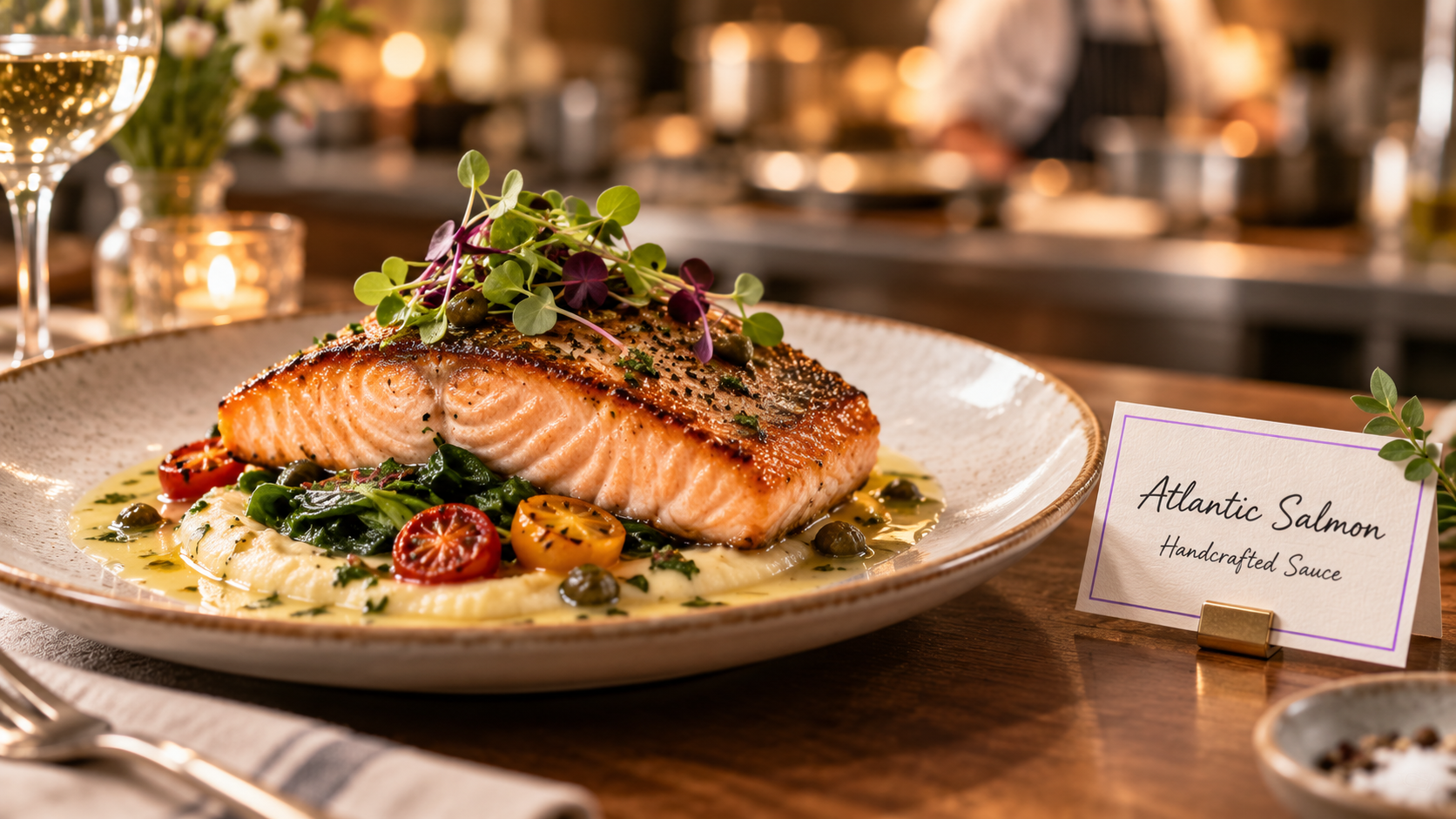
Many restaurants describe their menu items in a simple and functional way, using names such as "Grilled Salmon" or "Chicken Pasta." While these descriptions clearly tell customers what the dishes are, they do not communicate the details that influence value perception, such as ingredient quality, sourcing, preparation, or the craftsmanship behind the product.
A stronger menu description can help customers understand why a dish deserves its price. For example, instead of simply describing a dish as "Grilled Salmon," a restaurant could highlight the quality and origin of the ingredient by describing it as "Fresh Atlantic salmon paired with handcrafted sauce."
Similarly, mentioning seasonal ingredients, local sourcing, or carefully selected suppliers can create a stronger connection between the product and its perceived value.
Customers are not only purchasing the food itself. They are also purchasing the quality standards, preparation process, and attention to detail behind that product. This is especially important for premium and full-service restaurants, where storytelling can help customers understand why one menu item commands a higher price than another.
Common mistake:
Many restaurants rely on general words such as "premium," "special," or "high-quality" without explaining what actually makes the product different. Effective value communication is not about simply telling customers that a dish is better — it is about showing them the specific reasons why it is worth choosing.
② Highlight Preparation Methods to Turn Time and Technique Into Value
The way a dish is prepared can significantly influence how customers evaluate its value. Preparation methods communicate effort, expertise, and craftsmanship, which can make a product feel more distinctive.
For example:
Basic description:
"Beef Noodles"
Enhanced description:
"12-hour slow-cooked beef broth with handmade noodles"
These two descriptions create completely different perceptions. The first tells customers what the product is. The second helps customers understand the time, skill, and preparation involved.
Details such as slow cooking, handmade preparation, made-to-order techniques, or specialized cooking methods help customers understand that they are not simply paying for ingredients, but also for the skill and process behind the final product.
This approach is particularly valuable for restaurants that invest heavily in preparation quality but struggle to justify premium pricing. If customers cannot see the effort behind a product, they may compare it only based on ingredients and price.
Common mistake:
Many restaurants invest significant time and resources into improving their food quality but fail to reflect those efforts in their menu descriptions. Without clear communication, the additional value created behind the scenes may not translate into stronger customer willingness to pay.
③ Optimize Portion Size and Presentation to Improve Price Acceptance
Customers do not judge whether a menu item is worth the price based only on the number shown on the menu. Visual presentation, portion design, and overall appearance also influence purchasing decisions.
A well-designed presentation can increase perceived value without necessarily increasing production costs. Thoughtful plating, balanced portion sizes, and high-quality food photography can help customers develop stronger expectations before they even taste the product.
For example, the same dessert can create completely different impressions depending on how it is presented. A simple dessert placed on a plate may feel like an ordinary menu item, while a carefully designed presentation with layered textures, thoughtful plating, and visual details can transform it into part of the overall dining experience.
However, improving value perception does not always mean increasing portion size. In some cases, oversized portions may reduce the sense of quality while putting unnecessary pressure on profit margins.
Common mistake:
Some restaurants assume that providing more food automatically creates higher customer satisfaction. In reality, successful menu design requires finding the right balance between customer expectations, perceived quality, and profitability.
④ Integrate Service and Experience Into Product Value
Restaurants do not only sell food. The environment, service, atmosphere, and overall experience also influence how customers evaluate price.
For example:
Basic expression:
"Latte $6"
Enhanced expression:
"Handcrafted signature latte featuring seasonal flavors"
The product itself may be similar, but the second description creates a stronger sense of uniqueness and craftsmanship.
Although the physical product may be similar, the second description helps customers understand that they are paying for more than just a beverage. They are paying for the experience associated with the brand.
This principle applies across different restaurant categories. Whether it is a premium dining experience, a specialty coffee shop, or a casual restaurant with a unique concept, the menu should communicate the complete value customers receive.
Restaurants should therefore consider one important question:
Does your menu price reflect the full experience customers are actually receiving?
3. Four Psychological Pricing Strategies That Make Menus More Profitable
Improving perceived value is only one part of effective menu pricing. Restaurants also need to understand how the structure and presentation of prices influence customer decisions.
Customers rarely evaluate menu items in isolation. Instead, they compare different options, consider surrounding prices, and use the overall menu structure to determine whether a product feels reasonable.
This is why the same dish can achieve very different sales results depending on how it is positioned on the menu.
By applying psychological pricing strategies, restaurants can guide customer decisions more effectively while improving profitability.
① Anchor Pricing: Creating a Value Reference Point Through Premium Options
Many restaurants assume their highest-priced menu item must be designed mainly for direct sales.
However, premium items serve another important purpose:
They create a reference point that influences how customers perceive other prices.
This is known as Anchor Pricing.
When customers first see a high-priced option, their brains naturally establish a reference point and use it to evaluate other choices.
For example:
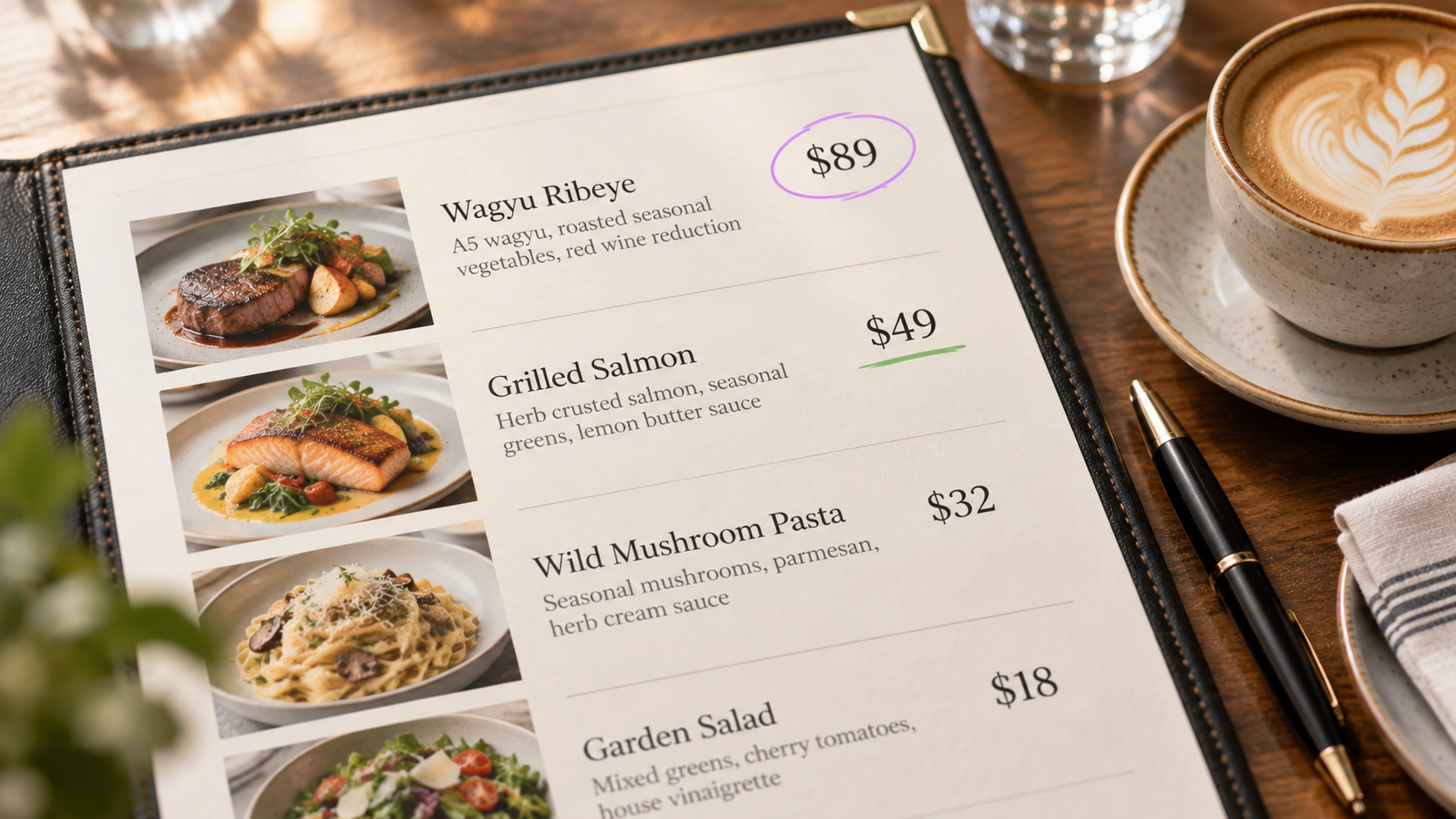
Premium Wagyu Steak — $89
Signature Ribeye — $49
Classic Steak — $32
After seeing the $89 Wagyu Steak, the $49 Signature Ribeye appears more reasonable and accessible. Without the premium option, customers may consider a $49 steak expensive. However, when compared with a higher-priced alternative, the same product becomes a more attractive choice.
Why Does Price Anchoring Work?
Customers rarely evaluate prices in isolation. Their decisions are usually influenced by comparisons, including:
The highest-priced option within a category;
The difference between similar products;
The perceived value between different menu levels.
Research shows that price anchoring can significantly influence purchasing decisions. Some menu testing studies have found that strategic price anchoring can increase average check size by approximately 6.8% without requiring restaurants to increase prices across the entire menu.
How Restaurants Can Apply Price Anchoring
A common approach is to introduce premium options within important menu categories.
For example:
A steak section can include premium Wagyu, chef's signature selections, and classic steak options;
A wine list can include reserve selections, premium bottles, and signature wines.
These premium choices do not only create additional sales opportunities. They also help customers better understand the pricing structure of the entire menu.
Connection With Menu Engineering
Price anchoring works particularly well when combined with Menu Engineering strategies.
Some menu items may have strong profit margins but receive fewer orders because customers do not immediately understand their value. By introducing premium reference points, restaurants can reshape customer perception and increase the likelihood that these profitable items are selected.
Common Mistake
Price anchoring does not mean simply adding the most expensive item possible.
If a price feels disconnected from the restaurant's positioning — for example, a casual restaurant introducing a $300 main course — customers may not perceive other items as better value. Instead, they may feel that the premium option is irrelevant to them.
An effective anchor price should:
Match the restaurant's brand positioning;
Create a reasonable comparison with other products;
Help customers understand differences in value.
In many cases, an anchor price around 25%–35% higher than the target product can create a stronger comparison without feeling unrealistic.
② Charm Pricing: Using Price Psychology to Influence Purchase Decisions
Many restaurants have noticed that the difference between $19.99 and $20 is only one cent, but customers often perceive these two prices differently.
This is the principle behind Charm Pricing.
The strategy is based on the left-digit effect, where customers tend to focus more on the first number they see when quickly scanning prices.
For example:
$19.99 is often perceived as "under $20";
$20 is more likely to be perceived as a $20-level purchase.
Although the actual difference is minimal, the psychological impression can influence purchasing decisions.
Different Restaurant Concepts Require Different Pricing Approaches
Charm pricing is not suitable for every restaurant. The right approach depends on the restaurant's positioning and customer expectations.
For fast-casual restaurants, delivery businesses, and promotional menus, pricing formats such as $9.99, $14.95, or $19.99 can strengthen perceptions of affordability, convenience, and value by creating a stronger sense of accessibility and price attractiveness.
However, premium and fine dining restaurants often use the opposite approach.
Instead of pricing a dish at $44.99, they may use a simpler number such as $45. They may also reduce visual emphasis on currency symbols, allowing customers to focus less on spending and more on the overall experience.
This approach helps communicate:
Premium positioning;
Confidence;
Product quality.
Connection With Menu Engineering
Charm pricing can support different Menu Engineering categories by adjusting how customers perceive value.
For example:
Stars (High Popularity, High Profitability): Appropriate pricing can maintain strong demand while protecting margins.
Plowhorses (High Popularity, Low Profitability): Strategic price adjustments can improve profitability without significantly affecting customer demand. For example, increasing a product price from $19.99 to $21 may improve profit margins if customers already recognize the product's value.
Common Mistake
Many restaurants assume every menu item should use prices ending in .99.
However, pricing formats should match brand positioning. For premium restaurants, using too many discount-oriented price endings may unintentionally reduce the perception of quality and exclusivity.
③ Bundle Pricing: Reducing Decision Complexity Through Product Combinations
Many customers hesitate to add more items to their orders not because they do not want to spend more, but because comparing multiple options can make the decision-making process more complicated. They may need to consider the price of the main dish, whether adding a drink is worthwhile, or whether adding a dessert provides enough value.
When customers need to evaluate too many individual options, the ordering process becomes more difficult. Bundle Pricing helps solve this problem by combining multiple products into one package, reducing the need for customers to compare each item separately and making the purchase decision easier.
Common applications include:
Fast food restaurants combining a main item, side dish, and beverage into a set meal;
Full-service restaurants creating fixed-price menus that include appetizers, main courses, and desserts;
Coffee shops combining beverages with pastries or snacks.
These approaches not only improve convenience for customers but can also encourage additional purchases and increase overall order value.
Restaurants Should Focus on More Than Average Order Value
A common mistake when designing bundles is focusing only on whether the average order value increases.
A higher-priced bundle does not always mean higher profitability. If a bundle includes too many low-margin products, it may increase sales revenue without creating meaningful profit growth.
When designing product combinations, restaurants should evaluate:
Product costs;
Contribution margin;
Overall profitability after combining different items.
Connection With Menu Engineering
Bundle Pricing can help restaurants strategically combine different product categories. For example, high-margin beverages, desserts, or side dishes can be paired with popular main courses to increase overall profitability.
By analyzing customer purchasing behavior, restaurants can identify which products are frequently purchased together and which combinations can create stronger profit opportunities. This allows restaurants to design more effective bundles based on actual customer behavior rather than relying only on assumptions.
④ Dynamic Pricing: Optimizing Menu Strategies Based on Demand Changes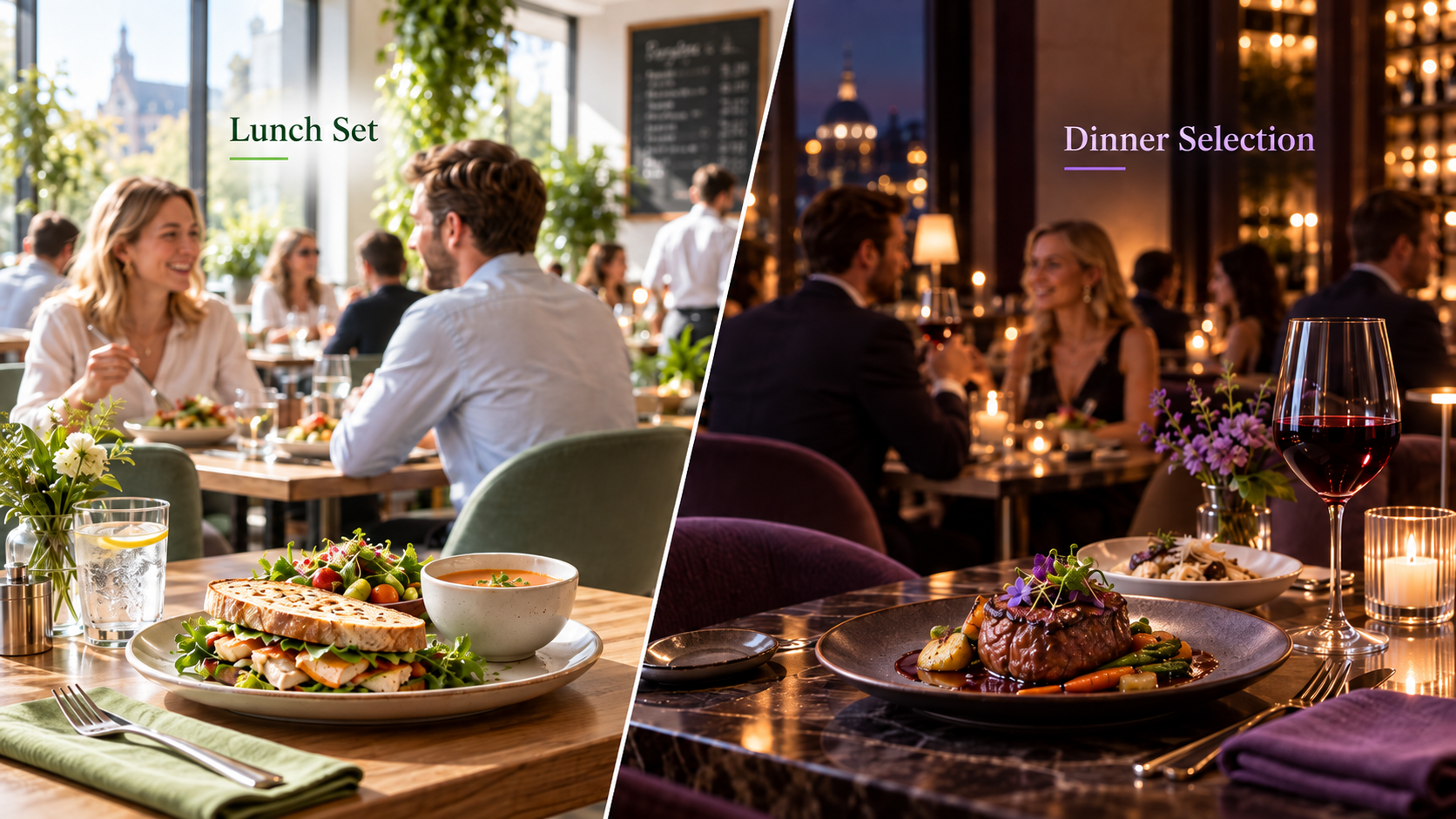
Dynamic Pricing does not simply mean increasing prices during high-demand periods.
For restaurants, the more important opportunity is adjusting menu strategies based on different time periods, customer needs, and purchasing situations. Customer preferences and willingness to pay can change throughout the day.
For example:
During lunch hours, customers may prioritize speed, convenience, and value;
During dinner hours, customers may place greater importance on quality, experience, and signature dishes.
Traditional paper menus make these adjustments difficult because any change requires redesigning and reprinting physical materials. Digital menus provide greater flexibility, allowing restaurants to optimize menu presentation according to different operational needs:
Breakfast periods can highlight breakfast sets;
Lunch periods can recommend quick combinations;
Dinner periods can feature premium dishes and signature selections.
Restaurants can also adjust product rankings and recommendations based on sales performance, time periods, and customer preferences.
Connection With Menu Engineering
Dynamic optimization represents an important part of continuous Menu Engineering.
A menu should not be treated as a fixed document that is created once and never changed. Instead, it should continuously evolve based on customer behavior, seasonal changes, and sales performance.
In the past, restaurants often struggled to evaluate whether pricing adjustments were effective because menu updates, sales analysis, and customer feedback were managed separately.
Digital menu systems and data-driven tools allow restaurants to continuously understand customer choices and optimize menu strategies based on actual purchasing behavior.
4. How Menu Design Influences Customer Price Acceptance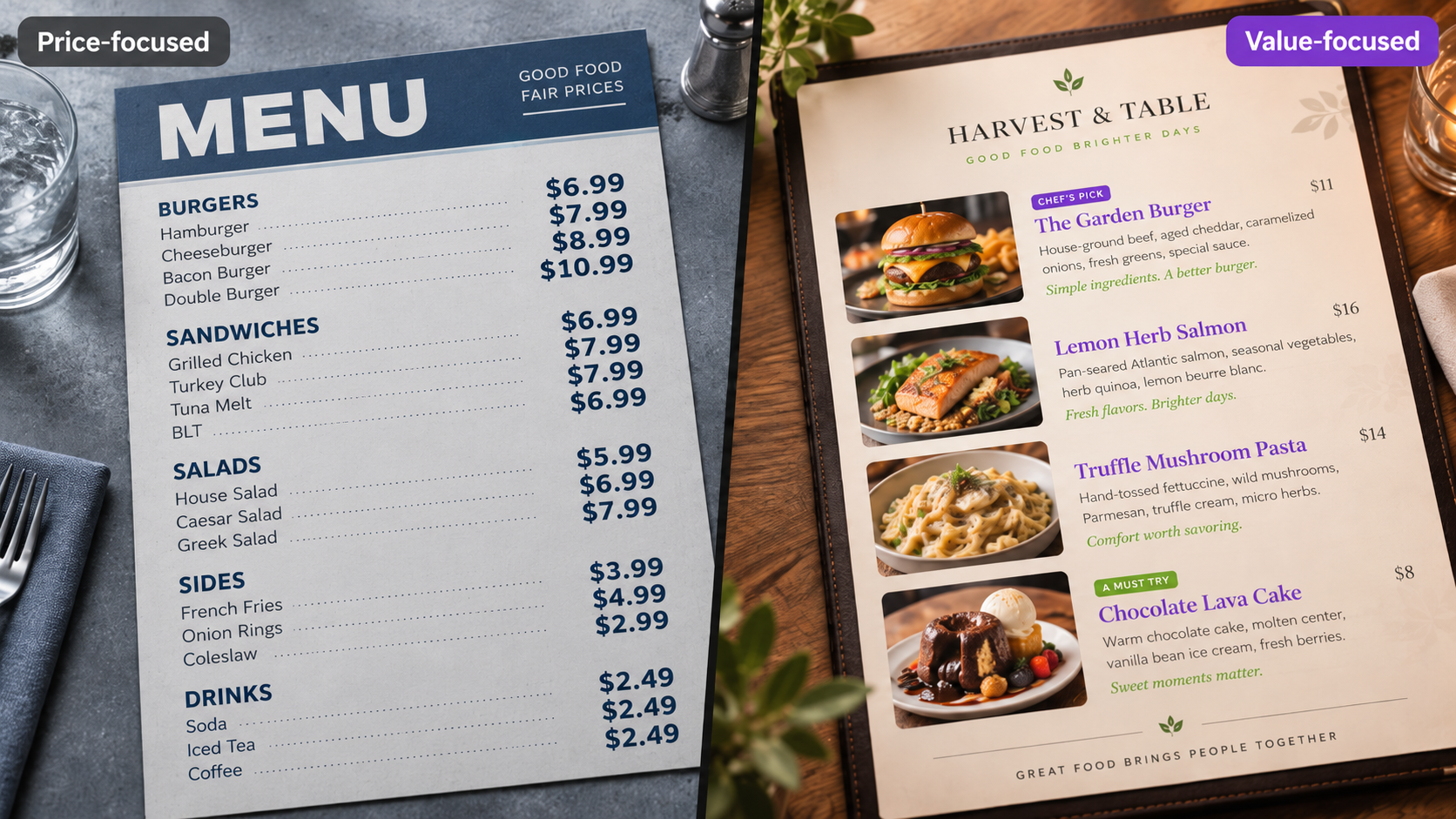
Price is only one part of the menu experience. Before customers even see a price, they are already influenced by menu layout, images, descriptions, and product positioning.
This is why menu design is not simply a visual consideration. It is an operational tool that can influence purchasing behavior.
Traditional paper menus require restaurants to consider information density, reading flow, price placement, and limited physical space. Since content cannot be updated frequently, every menu decision requires careful planning.
Digital menus provide greater flexibility. They allow restaurants to:
Update product descriptions;
Adjust product rankings and recommendations;
Display high-quality food images;
Test different product combinations;
Optimize based on customer data.
The biggest difference between the two is that a paper menu is a one-time design decision, while a digital menu can become a continuously optimized customer experience.
When restaurants move from traditional menus to digital ordering experiences, they gain more than a convenient display method. They gain a system that can continuously improve the customer decision journey.
For example, through a branded online ordering experience, restaurants can better showcase signature products, optimize menu presentation, and reduce friction during the ordering process.
How Can Restaurants Reduce Customer Price Sensitivity?
From a customer psychology perspective, restaurants can reduce price sensitivity in two main ways:
① Avoid Making Price the Only Visual Focus
When menu items are displayed primarily as a list of prices, such as "Burger $18, Steak $45, Pizza $22," customers naturally focus more on price comparison.
A better approach is to help customers notice the product name, images, descriptions, and key selling points first. Price should be one part of the decision-making process, rather than the only factor customers consider.
② Use Descriptions to Strengthen Product Value
A simple description such as "Chicken Pasta" can be enhanced into "Creamy handmade pasta with slow-cooked chicken and parmesan sauce."
A well-crafted description helps customers better understand why a product deserves its price and strengthens the perceived value before purchase.
5. How AI Helps Restaurants Optimize Menu Pricing
Traditional menu optimization often relies on store managers' experience, chef recommendations, and manual analysis of sales data. However, restaurants generate large amounts of operational information every day, and it can be difficult to identify the hidden opportunities within that data.
Many restaurant operators make menu decisions based on familiarity and past experience. However, the best-selling item is not always the most profitable one, and a menu that appears well-balanced may still contain overlooked opportunities for improvement.
For example:
Which products are currently underpriced?
Which menu items have stronger value potential?
Which product combinations can improve profitability?
Which descriptions fail to communicate the true value of a dish?
This is where artificial intelligence can help restaurants make more informed menu decisions.
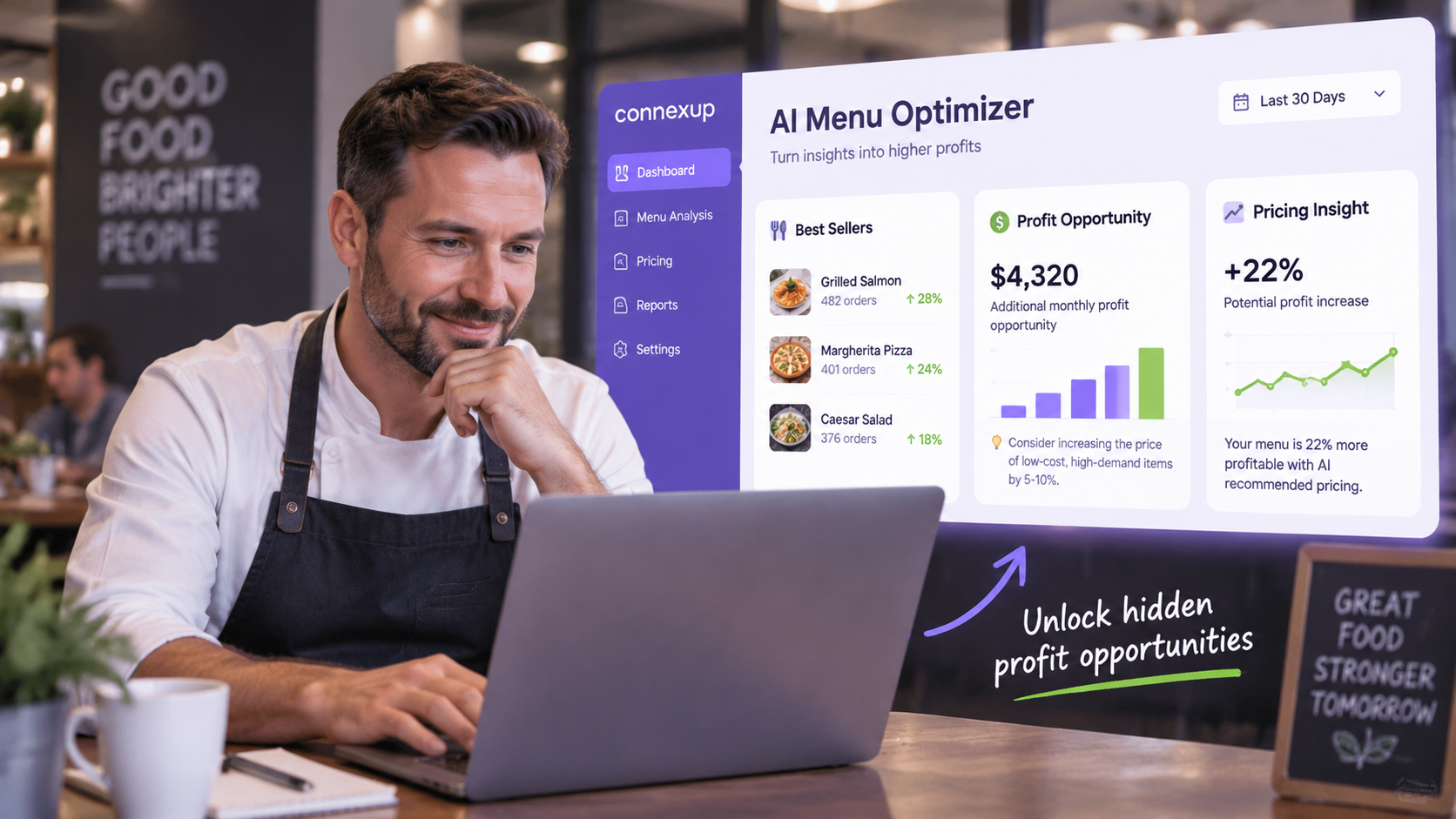
An AI-powered menu optimization tool can help restaurants:
① Analyze Menu Performance
AI can help restaurants analyze product sales performance, customer preferences, profitability, and overall menu structure.
Instead of relying only on assumptions, restaurant operators can better understand which products are truly driving revenue, which items have stronger growth potential, and which areas of the menu may require adjustment.
By combining menu information with performance insights, restaurants can make decisions based on actual data rather than intuition alone.
② Identify Pricing Optimization Opportunities
Pricing decisions are often challenging because restaurants need to balance customer expectations with profitability goals.
Through menu analysis, AI can help identify:
Products that may be priced too low compared with their perceived value;
High-value items that are not receiving enough attention;
Product combinations with stronger profitability potential.
This allows restaurants to discover pricing opportunities that may otherwise be overlooked and make adjustments based on data-driven insights instead of guesswork.
③ Optimize the Customer Ordering Journey
A menu is not only a tool for displaying products. It is also a guide that influences how customers discover, compare, and choose items.
AI can help restaurants optimize the customer decision journey by analyzing product positioning, menu structure, descriptions, and recommendation logic.
By creating a more intuitive ordering experience, restaurants can help customers find suitable products more easily while increasing opportunities for upselling and additional purchases.
④ Generate More Effective Menu Descriptions
Many restaurants have valuable products but fail to communicate that value effectively.
A dish may use high-quality ingredients, involve unique preparation techniques, or offer a distinctive experience, but if these details are not reflected in the menu description, customers may not recognize the difference.
AI can help optimize:
Menu item names;
Product descriptions;
Ingredient stories;
Preparation highlights.
By improving how products are presented, restaurants can strengthen customer understanding of value and create stronger connections between price and quality.
⑤ Recommend More Suitable Food Images
Visual presentation plays an important role in restaurant purchasing decisions.
High-quality food images can influence customer expectations and encourage customers to explore specific menu items.
AI can help restaurants identify and recommend suitable food images from existing media resources, allowing menu items to be presented in a more appealing and effective way.
⑥ Quickly Scan and Import Existing Menus
For restaurants with existing menus, reorganizing and optimizing menu content manually can require significant time and effort.
AI can help quickly scan existing menu information, digitize menu content, and provide a foundation for further optimization.
This allows restaurants to move from traditional menu management toward a more efficient digital workflow.
The value of AI is not simply replacing manual menu adjustments. More importantly, it helps transform menu optimization from a one-time task into a continuous process of analysis, improvement, and refinement.
By combining menu data, customer behavior insights, and pricing psychology, restaurants can more accurately identify overlooked profit opportunities, products with stronger value potential, and more effective sales combinations.
6. From Price List to Profit Growth System
Menu pricing psychology is not about manipulating customers into spending more. A truly effective pricing strategy helps customers better understand product value and make confident purchasing decisions.
Successful restaurants do not only ask:
"Why does this dish cost us?"
They also ask:
"Why are customers willing to pay this price?"
By combining cost analysis, customer psychology, Menu Engineering, and data-driven optimization, restaurants can build a menu system designed for continuous profitability improvement.
A great menu should not simply be a list of products and prices. It should become an operational asset that helps restaurants increase revenue, improve customer experience, and support long-term growth.
If your menu decisions are still based mainly on experience rather than data-driven insights, now is the right time to rethink your menu strategy.
Connexup's AI Menu Optimizer helps restaurants analyze menu data, order performance, and customer purchasing behavior to identify overlooked high-value products, potential profit opportunities, and pricing or positioning issues that may be limiting growth.
More importantly, menu optimization should not stop at identifying opportunities. Once restaurants discover new pricing strategies or menu improvements, Connexup allows them to manage updates through a centralized admin portal and synchronize changes across multiple ordering channels, including web ordering, self-service kiosks, and mobile apps, without needing to update each platform individually.
By connecting data insights, menu management, and digital ordering experiences, Connexup helps restaurants transform their menus from simple product displays into intelligent operational systems that continuously improve, increase average order value, and drive revenue growth.