Local SEO vs Google Ads: How Restaurants Should Choose the Right Google Growth Strategy
Connexup Team
Aug 28, 2026
For restaurant owners, the goal of online marketing is straightforward: how can you help more potential customers discover your brand and turn that attention into real visits and sales?
However, when restaurants start investing in Google marketing, many owners find themselves facing a difficult question:
Should we invest in Google Ads to gain immediate visibility, or should we focus on Local SEO to build long-term search presence?
The challenge is that many businesses see these two approaches as competing options — as if paid traffic and organic visibility require an either-or decision.
But in reality, Google Ads and Local SEO support different stages of business growth.
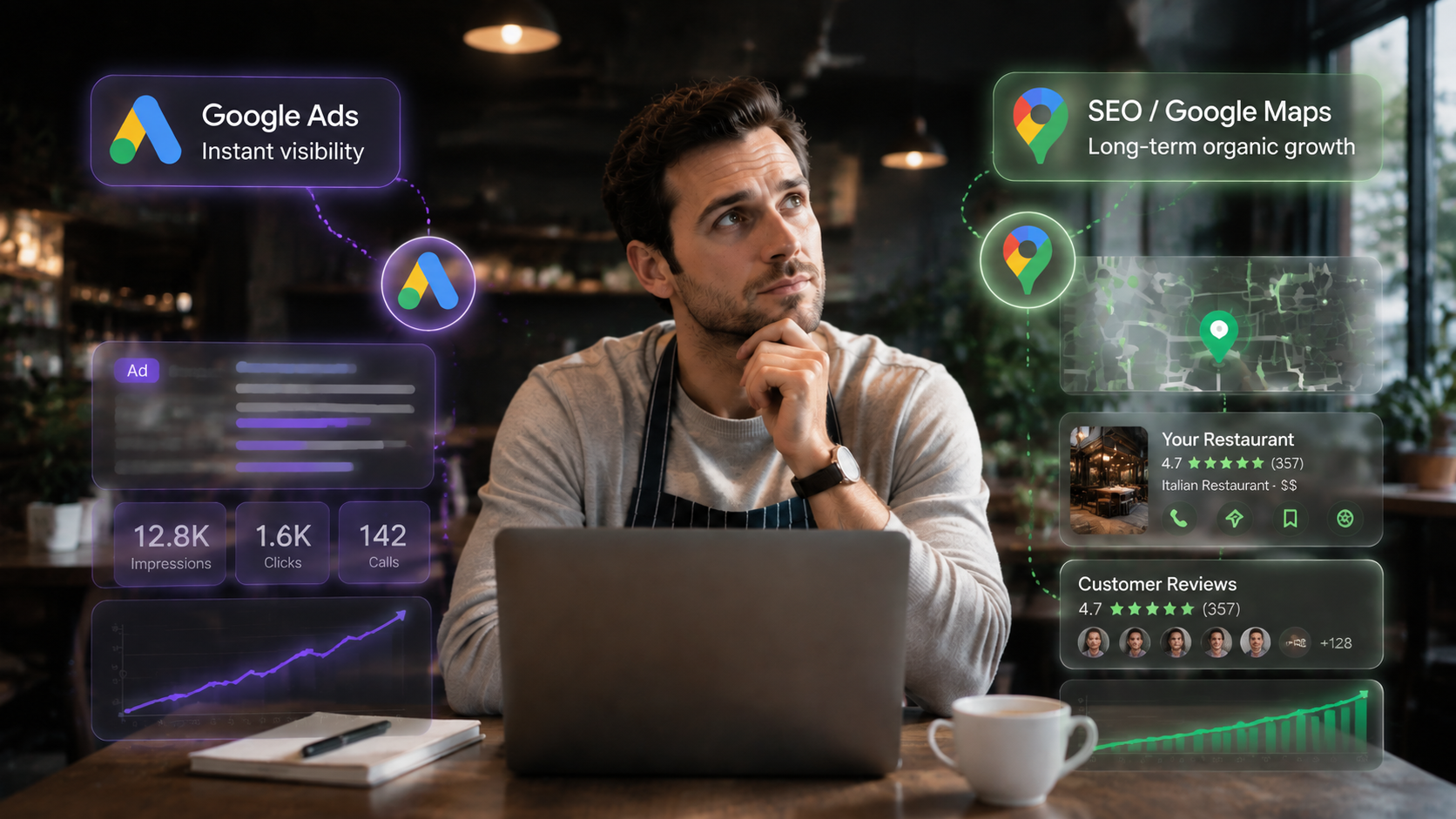
Google Ads is designed to address immediate needs. When a restaurant is launching a new location, promoting a limited-time offer, or trying to increase visibility during a specific period, paid advertising can help the brand reach relevant customers quickly and generate awareness.
Local SEO, on the other hand, focuses on long-term growth. By improving how a restaurant appears across Google Search, Google Maps, and other relevant online touchpoints, Local SEO helps businesses become more visible and trustworthy when customers are actively looking for dining options.
Therefore, the real question for restaurants is not:
“Which one is better — SEO or Google Ads?”
The better question is:
“At this stage of my business, do I need to solve an immediate customer acquisition challenge, or build long-term search visibility?”
Only by understanding the restaurant’s current situation can businesses create a Google marketing strategy that truly matches their growth goals.
1. Google Has Become an Important Decision-Making Channel for Restaurant Customers
In the past, restaurants mainly relied on offline factors to attract customers: location, word-of-mouth recommendations, repeat customers, and social media exposure.
These factors remain important today. However, the way customers discover and evaluate restaurants has changed.
Many customers no longer start by knowing a restaurant’s name and then searching for more information. Instead, they often begin with a dining need, turn to Google to explore their options, and compare different restaurants before deciding where to go.
This means restaurant competition is no longer limited to physical locations or nearby foot traffic. It also happens during the digital decision-making process, when customers are researching, comparing, and evaluating their choices.
For customers, Google is no longer just a tool for finding an address. It has become a reference point that helps reduce uncertainty before making a decision.
Before choosing a restaurant, customers often consider factors such as:
What type of food and dining experience does the restaurant offer?
Is the location convenient?
Do customer reviews feel trustworthy?
Do the photos represent an appealing experience?
Are important details such as menus and opening hours clear?
Together, these factors shape how customers perceive a restaurant and influence whether they decide to visit.
This means that even restaurants with excellent food and service can miss opportunities if they are not visible at the moment customers are making decisions.
On the other hand, restaurants that actively manage their Google presence, maintain accurate information, and build online trust are more likely to turn search activity into real visits.
This is why Google Search has become an increasingly important part of restaurant growth strategies.
Within this journey, Google Ads and Local SEO serve different purposes:
Google Ads helps restaurants gain immediate visibility and attention.
Local SEO helps restaurants build long-term search visibility and trust.
They are not competing strategies. Instead, they address different needs at different stages of growth.
2. Google Ads: Helping Restaurants Gain Immediate Visibility
The biggest advantage of Google Ads is speed.
Google Ads allows restaurants to quickly place their brand in front of potential customers who are already showing relevant interest.
For a newly opened restaurant, this can be especially valuable.
Even with an excellent menu, thoughtful interior design, and great service, a new restaurant still faces one major challenge:
People do not know you exist yet.
If a restaurant relies only on organic discovery and word of mouth, building awareness can take time.
Google Ads helps shorten that process by increasing the chances that potential customers discover the brand when they are actively looking for relevant dining options.
For restaurants that need early traction and market feedback, this immediate visibility can be highly valuable.
When Should Restaurants Consider Using Google Ads?
① New restaurants that need to build awareness quickly
For new restaurants, the first challenge is often not the product itself — it is visibility.
Customers may not know the brand, understand its positioning, or recognize what makes it different from competitors.
Google Ads can help new restaurants enter the customer’s consideration process earlier and collect valuable insights, such as which offerings attract attention and which customer groups are more likely to engage.
For restaurants trying to build their first customer base, this type of immediate exposure can provide a strong starting point.
② Promoting time-sensitive campaigns and offers
The restaurant industry often relies on opportunities with limited time windows, such as:
Seasonal menus;
Weekend brunch promotions;
New menu launches;
Special dining events.
The value of these campaigns is often concentrated within a specific period.
Unlike organic search visibility, which requires time to build, Google Ads allows restaurants to quickly reach customers who are interested in these experiences and increase campaign exposure during the right moment.
③ Competing in highly competitive markets
In areas with many restaurants offering similar cuisines and experiences, competition for customer attention can be intense.
When customers have many options, restaurants that appear prominently in search results have a better chance of being considered.
For new brands or restaurants entering a new market, Google Ads can serve as a short-term competitive tool, helping them gain visibility before building stronger organic rankings.
However, Google Ads Is Not the Only Answer for Long-Term Growth
While Google Ads can deliver fast visibility, restaurants also need to understand its limitations.
First, advertising requires continuous investment.
When the budget stops, the visibility generated by ads also disappears.
In other words, Google Ads helps restaurants purchase customer attention at a specific moment, but that exposure does not automatically become a long-term business asset.
Second, clicks do not always equal business results.
Many restaurants focus heavily on impressions and clicks, but the more meaningful question is whether those actions lead to:
Reservations;
Phone inquiries;
Direction requests;
Actual visits.
Without proper tracking, restaurants may spend significant amounts on advertising without knowing whether it is truly contributing to business growth.
Therefore, the value of Google Ads is not simply about generating more clicks. Its real value comes from using clear business goals and data insights to ensure every investment supports measurable results.
3. Local SEO: Building Long-Term Search Visibility for Restaurants
If Google Ads is about purchasing immediate visibility, Local SEO is about building a sustainable ability to be discovered.
For restaurants, Local SEO is not simply a technical exercise focused on improving rankings.
Instead, it is a broader online visibility strategy built around the customer decision journey.
It includes how a restaurant appears across Google Search, Google Maps, and other local online touchpoints — including whether business information is complete, customer reviews are trustworthy, and online content accurately communicates the restaurant’s value.
All of these factors influence one key question:
When customers discover your restaurant, do they have enough confidence to learn more and choose to visit?
Google Business Profile: A Critical First Impression for Customers
For local restaurants, Google Business Profile is often one of the first places customers encounter a brand during their search journey.
When potential customers view a restaurant listing, they typically pay attention to:
Location convenience;
Accurate opening hours;
Clear menu information;
Authentic photos;
Customer reviews.
These details help Google better understand the restaurant while also shaping the customer’s first impression of the brand.
A complete and regularly maintained Google Business Profile helps restaurants build trust during the consideration stage.
On the other hand, outdated information, incorrect opening hours, old photos, or unanswered reviews can create uncertainty — even if the restaurant itself offers a strong product and experience.
Website: Helping Customers Better Understand Your Restaurant’s Value
Within the framework of local SEO, a restaurant's official website plays a role that extends far beyond mere information display; it simultaneously serves as a vital vehicle for conveying brand value.
Many restaurant owners see their website as a basic information page. However, from both a search and customer decision perspective, a well-structured website helps customers better understand what makes the restaurant unique while helping Google better recognize the brand’s positioning.
For example, a restaurant is rarely just a place that serves a certain type of cuisine.
It may offer:
A relaxed environment designed for family gatherings;
A premium dining experience focused on quality ingredients and craftsmanship;
A convenient option for business lunches;
A memorable setting for birthdays, celebrations, and special occasions.
These differences are often what influence a customer’s final decision. However, if this information only exists through social media posts or offline promotions, potential customers may not discover it when they are actively comparing restaurants.
Through a well-developed website, restaurants can clearly communicate:
What type of dining experience they provide;
Which dishes represent their signature offerings;
What occasions or customer groups they are best suited for;
Why customers should choose them over similar restaurants.
This type of content not only supports search visibility but also helps customers make faster and more confident decisions when comparing different options.
For restaurants focused on long-term growth, a brand website should not be treated as a static online brochure. Instead, it should become an important connection point between customer search intent and the restaurant’s brand value.
Customer Reviews: A Key Factor in Search Visibility and Customer Decisions
One of the biggest differences between the restaurant industry and many other industries is that customers heavily rely on real experiences when making decisions.
When considering a restaurant they have never visited before, many customers look at online reviews to understand what others experienced. They often pay attention to:
Overall ratings;
The number and quality of reviews;
Recent customer feedback;
Photos shared by real customers.
These reviews do more than influence customer trust. They can also determine whether someone decides to learn more about the restaurant or choose another option.
From this perspective, Local SEO is not only about improving search rankings. It is also about building a stronger online reputation that increases customer confidence.
Restaurants that consistently collect authentic reviews and actively respond to customer feedback gradually build stronger trust signals.
On the other hand, restaurants that ignore review management may lose opportunities during the comparison stage, even if they provide excellent food and service.
This is why Local SEO should be viewed as an ongoing business effort rather than a one-time technical adjustment. It requires continuous attention to how the restaurant is represented and perceived online.
4. The Hidden Value of Google Ads: Helping Restaurants Understand Customer Demand
Many restaurant owners tend to think of Google Ads in fairly narrow terms—more clicks, more impressions, more eyeballs. And while that's certainly the most visible benefit, for restaurants that are actively building out their digital presence, advertising offers another, often overlooked advantage:
It helps brands understand what their customers actually care about.
The data generated from a well-run ad campaign is, in effect, a rich source of real-world market feedback. By digging into the numbers, restaurant operators can start to see patterns emerge:
Which search queries or need-states are most likely to prompt a response;
Which menu descriptions or selling points resonate most strongly with potential diners;
Which customer segments tend to convert at higher rates and deliver greater long-term value.
Consider a typical scenario: a restaurant opens with the firm belief that its core appeal lies in serving "authentic cuisine." After running Google Ads for a few weeks, however, the data tells a slightly different story—potential customers are far more drawn to phrases like "great spot for a date night" or "perfect for weekend family gatherings."
That kind of insight is gold. It pulls the owner out of an internal, assumption-driven mindset and grounds future marketing decisions in what the market is actually telling them.
This is precisely why Google Ads and local SEO shouldn't be viewed as separate, competing efforts. Ads are excellent for testing hypotheses quickly; SEO excels at taking what works and turning it into lasting content that keeps paying dividends over time.
For example, if ad data shows that a particular search intent generates significantly more reservation inquiries, that's a signal worth acting on. The restaurant can then extend that learning across multiple touchpoints:
Refining the structure and messaging of relevant website pages;
Adjusting menu copy to highlight the attributes that actually drive interest;
Updating the Google Business Profile description and category selections;
Building a long-term keyword strategy around that proven demand.
All of this feeds into a virtuous cycle:
Google Ads provides market insights → Local SEO turns those insights into a durable, compounding asset.
At the end of the day, the most effective growth framework for a restaurant isn't about choosing one channel over another—it's about integrating search visibility, customer feedback, and operational data into a single, coherent system. No single channel, no matter how powerful, can deliver sustainable results on its own.
5. Common Google Marketing Mistakes Restaurants Make
As more restaurants recognize the importance of Google visibility, many still make common mistakes when building their digital growth strategy.
Understanding these challenges can help restaurants avoid wasting time and budget.
Mistake #1: Focusing on clicks while ignoring real conversions
Many restaurants measure Google Ads performance by surface-level metrics—clicks, visits, impressions. But these numbers alone don't tell you whether your business is actually benefiting.
The more meaningful question is this: are those clicks turning into real actions? Are customers calling to make a reservation, requesting directions, completing a booking, or actually walking through your door?
Without a proper tracking system in place, it's nearly impossible to determine whether your ad spend is genuinely serving your business goals—or just burning budget on vanity metrics.
Mistake #2: Expecting SEO to deliver overnight results
Local SEO is, by nature, a long-term play. It doesn't work like advertising, where you can dial up the budget and see immediate visibility gains.
For a new restaurant looking to build a stable search presence, there are multiple layers that need to be developed over time: a complete and accurate business profile, a steady stream of authentic customer reviews, high-quality website content, and consistent brand signals across the web.
Think of local SEO as you would think of building your restaurant's reputation—it takes time to establish, but once you've earned that trust, it keeps working for you, without you having to pay for every single impression.
Mistake #3: Neglecting your Google Business Profile
It's not uncommon to see restaurants pouring significant energy into social media—posting frequently, engaging with followers, chasing the algorithm—while leaving their Google Business Profile outdated and unattended.
But here's the thing: for consumers who are actively searching for a place to eat, Google is often the final decision-making channel. And when potential diners come across inaccurate store hours, menu information that hasn't been updated in months, outdated photos, or customer reviews that have gone unanswered, those small oversights chip away at their trust in your brand.
Your Google Business Profile isn't a one-and-done setup task. It deserves to be treated as part of your day-to-day operations—kept accurate, current, and responsive.
Mistake #4: Spreading your budget too thin without a clear growth objective
Some restaurants, when they first venture into online marketing, try to do everything at once—Google Ads, local SEO, social media, and various other promotional channels. That approach can work if resources are abundant, but when budgets are limited, spreading your investment across too many fronts often means none of them get enough traction to make a real difference.
A more practical approach is to set clear priorities based on where your restaurant currently stands:
When your immediate challenge is bringing in new customers, lean more heavily into Google Ads;
When your focus shifts to lowering long-term acquisition costs, double down on local SEO;
When you're ready to build a sustainable growth engine, that's when you bring the two together in a coordinated strategy—not as competing efforts, but as complementary ones.
6. Choosing the Right Google Growth Strategy Based on Your Restaurant Stage
Not every restaurant needs the same marketing approach.
The right strategy depends on where the restaurant is currently positioned and what business challenge it needs to solve.
New Restaurants: Build Awareness While Establishing Long-Term Foundations
For a newly opened restaurant, the most immediate challenge is simple: customers don't know you exist yet.
In the launch phase, Google Ads can serve as an effective tool for generating quick visibility, helping your restaurant get in front of potential diners within a short timeframe.
At the same time, however, the groundwork for local SEO should be laid from day one—setting up a complete Google Business Profile, actively collecting and responding to real customer reviews, refining your website content, and building a long-term keyword strategy around your core menu offerings and service strengths.
This combination of short-term ad-driven traffic and long-term SEO accumulation allows your restaurant to build awareness while gradually reducing its reliance on paid media as the brand gains traction.
Growing Restaurants: Ease off the reliance on paid visibility
Once your restaurant has moved past the startup phase and built a solid customer base and some brand recognition, the focus typically shifts from "getting exposure" to "improving acquisition efficiency."
This is where the long-term value of local SEO really starts to shine. By consistently maintaining accurate and complete information on your Google Business Profile, accumulating and responding to customer feedback, enriching your website content, and strengthening your overall local search presence, you can steadily increase the share of traffic coming from organic search.
The result is a more stable, sustainable flow of new customers—and less dependence on ad spend to keep the doors busy.
Established Restaurants: Use Both Strategies to Support Long-Term Growth
For mature restaurants that already enjoy strong brand awareness and a loyal customer following, the synergy between Google Ads and local SEO becomes even more powerful.
At this stage, advertising is no longer just about driving traffic—it can also be used to test demand in new markets, promote seasonal or limited-time offerings, and gather competitive intelligence. Local SEO, on the other hand, takes on the role of reinforcing your brand's position in search results, lowering customer acquisition costs over time, and steadily building online assets that hold value well into the future.
When the two work in concert, your restaurant isn't just serving today's customers—it's continuously laying the groundwork for tomorrow's growth as well.
Conclusion: Restaurants Need More Than Clicks — They Need a More Stable Source of Customers
For restaurant owners, there is no simple winner between Google Ads and Local SEO.
Google Ads solves one key challenge:
How can restaurants quickly gain customer attention and test market demand?
Local SEO solves another:
How can restaurants continue to be discovered when customers are searching, comparing, and making decisions?
In the short term, ads deliver fast exposure and valuable market testing opportunities. In the long term, SEO helps brands build search assets that hold lasting value—visibility that doesn't disappear the moment you stop spending.
However, a truly effective growth strategy is never about choosing one over the other. It's about building a cohesive Google acquisition system—one where the real-time feedback from ads feeds into your long-term SEO efforts, and where the stable foundation of SEO, in turn, makes your ad spend more efficient and effective.
This is the real challenge many restaurant owners face in practice. They need more than just "being found by more people." They also need to keep their online information accurate, manage customer reviews authentically, present their brand in a compelling and complete way, and ultimately turn a single search into a lasting customer relationship.
For restaurants with long-term ambitions, growth shouldn't depend on scattered, one-off marketing tactics. What's needed is a complete loop that connects three essential stages:
Being discovered, being chosen, and being remembered.
That's precisely the kind of systemic challenge Connexup helps restaurants solve. Through local SEO optimization, Google Business Profile management, ongoing review maintenance, and systematic development of brand websites, Connexup helps restaurants improve their online visibility—ensuring more potential customers find them, and building a more stable digital foundation for sustainable growth.
When search has become the gateway through which most consumers discover dining options, what restaurants truly need isn't just a single campaign's worth of exposure. It's a complete growth system that continuously brings in new customers, strengthens brand value, and supports long-term success.