What a Restaurant Website Actually Needs to Convert in 2026 (It's Not a Prettier Homepage)
Connexup Team
Sep 4, 2026

When restaurants plan their brand website, the first things they usually focus on are visual elements: whether the images look premium enough, whether the layout feels polished, and whether the overall style matches the brand identity.
These elements are certainly important. A website that reflects the restaurant’s personality can help create a strong first impression.
However, for a digital asset that is truly designed to support business growth, success should never be measured by appearance alone.
The more important question is:
Is your website actually helping customers make a decision?
For today’s consumers, a restaurant website is no longer just an online brochure that introduces the brand. It has become an important touchpoint that influences purchasing decisions.
When customers arrive at a restaurant website through search engines, social media, or other channels, they usually already have a clear purpose: they want to view the menu, understand the restaurant’s concept, confirm opening hours and location, or make a reservation.
If your website cannot answer these needs quickly and clearly, even the most beautiful design may still result in losing potential customers without you realizing it.
That is why restaurant websites need to redefine their role in 2026.
A website should no longer simply display brand information. It should become a digital sales tool that helps restaurants attract visitors, build trust, and convert interest into real reservations or orders.
The real measure of success isn't how many visitors you get, but how many of those visits turn into tangible business outcomes.
1. From “Looks Good” to “Actually Works”: Restaurant Websites Are Entering the Conversion Era
In the past, restaurant websites mainly served as information platforms. Customers might visit a website simply to check opening hours, find contact details, or learn basic information about the brand.
Today, however, the customer journey has changed.
A typical dining decision may begin with a food photo on social media, followed by a search for more information, and finally a visit to the official website to check the menu, atmosphere, and reservation options.
Throughout this process, a website does more than provide information.
It helps customers quickly answer an important question:
“Is this a restaurant worth choosing?”
This is why the value of a restaurant website is shifting from simply “showcasing a brand” to actively “supporting customer decisions.” A high-performing website needs to understand what customers need at every stage of their journey and remove the obstacles that prevent them from taking action.
Mobile Experience Is the First Barrier to Conversion
The way customers discover restaurants is changing.
In the past, customers might already know a restaurant and then search for its website to learn more. Today, many customers first encounter a restaurant through social media, search results, or online recommendations. They then use the website to quickly decide whether the restaurant is worth visiting.
And most of this process happens on mobile devices.
This means mobile experience is no longer just an optional improvement for website design. It is a key factor that determines whether customers continue exploring your brand.
If a website loads slowly, hides important information, or provides a poor mobile browsing experience, customers are unlikely to spend time searching for answers. They may simply return to search results and choose another restaurant.
Website Speed Affects More Than Experience—It Affects Conversion
Website speed is often the first impression users have after entering a page. For restaurant websites, large high-quality images, complex visual effects, and poorly optimized website structures can all affect loading performance.
An effective website needs to balance visual presentation with loading speed, allowing customers to experience the brand atmosphere while still accessing information quickly.
Customers will not become more interested in a restaurant because they are waiting for a website to load. In many cases, the opposite happens — they simply lose patience and leave.
Mobile Design Should Match Real Customer Behavior
On a phone, customers typically want to do a few things quickly: browse the menu, find the location, check hours, and make a reservation.
That is why website information needs to be structured clearly. Important content should be easy to find, key action buttons should be visible, and information such as phone numbers and addresses should be easy to access.
Good mobile design isn't about shrinking a desktop site to fit a smaller screen—it's about rethinking how someone on the go makes a dining decision.
The Homepage Must Build Recognition and Encourage Action Quickly
The first few seconds on your site usually determine whether a visitor stays or leaves. Your homepage—especially the part visible without scrolling—must answer two questions instantly:
“What kind of restaurant is this?”
“What should I do next?”
Strong brand positioning, compelling visuals, and clear calls-to-action—like “View Menu,” “Book a Table,” or “Order Online”—help visitors move forward without hesitation.
2. A Menu Is More Than a File — It's a Key Sales Asset
For most restaurants, the menu is one of the most important parts of the website. But its value goes far beyond simply telling customers what's available to eat today.
A well-optimized menu enhances the browsing experience for visitors while also improving your restaurant's visibility in search engines – helping you attract more potential guests.
The Problem: PDF and Image-Based Menus Are Hurting Your Conversions
Many restaurants still upload their menus as PDFs or images. While this approach may seem convenient, it creates three core issues:
① Poor mobile browsing experience – customers have to constantly zoom in and drag around just to read the content;
② Search engines can't read the information – dish names, ingredient descriptions, and prices in images or PDFs are virtually invisible to search indexing;
③ Updates are inefficient – every menu change requires recreating and re-uploading the entire file, which is time-consuming and prone to errors.
Best Practice: Replace Static Files with an HTML Menu
Presenting your menu directly as an HTML page on your website gives customers a smooth, seamless browsing experience while allowing your restaurant's unique offerings to shine:
① Include keywords in dish names and write detailed, specific descriptions
Naturally incorporate relevant keywords into dish names (e.g., "House-Made Pappardelle" rather than just "Pasta") and describe the key ingredients, preparation methods, and flavor profiles.
This helps customers understand what they're ordering while giving search engines meaningful content to index.
② Ensure prices are visible to search engines
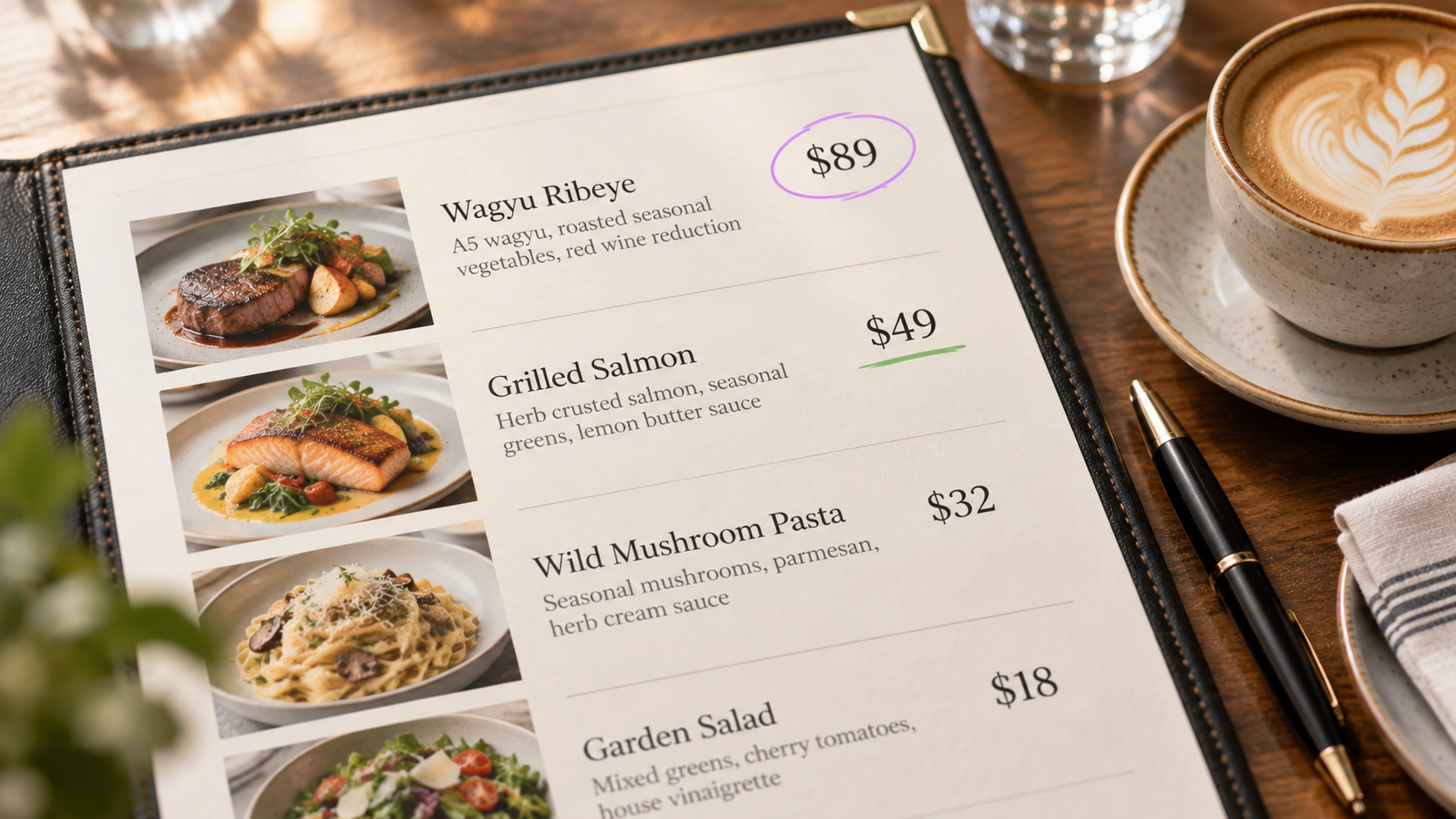
Pricing is a critical factor in customer decision-making. Display prices directly as HTML text rather than embedding them in images. Clear, crawlable pricing not only improves conversion rates but also aligns with search optimization best practices.
③ Organize categories clearly and use heading tags to structure your content
Use H1, H2, and H3 tags appropriately to divide your menu into logical categories – such as Appetizers, Main Courses, Desserts, and Beverages. This improves readability for customers and helps search engines understand the hierarchy and relevance of your content.
Sample Code Structure:
 With these optimizations in place, your menu page transforms from a simple price list into an asset that helps customers make confident decisions, reinforces your brand's professionalism, and consistently contributes to your website's search visibility over time.
3. Trust Must Be Earned Before the Reservation, Not After
Many restaurants assume that as long as they clearly display their dishes, prices, and contact information, customers will naturally choose them.
But the reality is that when consumers discover a restaurant for the first time, they are not only asking: “Am I interested?” They are also asking: “Can I trust this restaurant?”
Especially for higher-end restaurants, niche concepts, or newly established brands, customers often look for additional signals before making a reservation:
Is the quality reliable?
Does the actual environment match my expectations?
Is this the right place for my dining occasion?
If these questions are not answered through your brand website, potential bookings may quietly disappear before customers ever take the next step.
① Use Authentic, High-Quality Visuals to Set Proper Expectations
Dining is a sensory, experience-driven purchase. Compared with plain descriptions, authentic food photography, restaurant interiors, and real dining scenes help customers build expectations and understand the atmosphere of your brand before they visit.
But the key factor is authenticity.
If the content displayed on your website feels disconnected from the actual experience, it can damage trust and leave customers feeling disappointed.
Instead of relying on overly polished or unrealistic images, restaurants should showcase a genuine and approachable representation of their brand.
To achieve this, restaurants can consider the following:
Prepare professional photography that covers signature dishes, restaurant interiors, and real dining moments, allowing customers to understand both the food and the overall experience.
Ensure food photography highlights the quality and details of each dish, while maintaining a natural visual style.
Show the real atmosphere of the restaurant through interior and environment photos, avoiding excessive editing that creates unrealistic expectations.
Maintain a consistent visual style across all images to strengthen brand recognition.
The goal is not simply to make the website look attractive, but to help customers imagine the experience they will have when they visit.
② Showcase Real Reviews and Third-Party Recognition
Customer reviews and external recognition are equally important in building trust. People naturally place more confidence in the experiences of other customers than in a brand’s own promotional messages.
A review that mentions a specific dish, service detail, or dining experience is often far more persuasive than a simple comment like “great restaurant” or “delicious food.”
By showcasing authentic reviews, media coverage, and industry recognition, restaurants can create additional credibility and reduce uncertainty for first-time visitors.
Restaurants can consider:
Selecting meaningful customer reviews from platforms such as Google Maps, especially those that mention specific dishes, service experiences, or unique details rather than generic comments.
Including review information such as the reviewer’s name and date when displaying customer feedback, helping increase authenticity.
Creating dedicated sections for media features, awards, or industry recognition if the restaurant has received external attention.
Highlighting selected customer feedback on key website pages to reinforce trust during the decision-making process.
These external signals not only show that others have enjoyed your restaurant—they also help new customers overcome the uncertainty of a first visit.
③ Build Emotional Connection Through Your Brand Story
A good brand story is another underrated trust asset. In a crowded market, simply stating “we serve X cuisine” isn't enough anymore. People want to know why your restaurant exists, what principles you stand for, and what kind of experience you're striving to create. A genuine story—told in the first person—can set you apart.
Restaurants can consider:
Using the “About Us” page to share the founder’s story and the reason behind creating the restaurant.
Keeping the story focused and meaningful, supported by authentic images of the founders, team, or kitchen operations.
Answering key questions: Why was this restaurant created? What makes its approach unique? What experience can customers gain here that they may not find elsewhere?
Highlighting unique elements such as ingredient sourcing, special cooking techniques, or signature preparation methods (e.g., “45-day dry-aged steaks,” “daily flown-in Hokkaido uni”), as these can become valuable trust signals.
A sincere brand story is more than a timeline; it's an emotional bridge that helps customers connect with your values.
4. Remove Friction So Interest Turns Naturally Into Action
Many restaurant websites don't lack visitors—they lose them at the final step.
A customer may arrive with genuine interest, only to abandon the process due to needless friction: a reservation button that's hard to find, a clunky redirect to a third-party platform, an overly long booking form, or unexpected fees that appear only at checkout.
Each of these small obstacles, on its own, might seem minor—but together, they steadily chip away at your conversion rate.
① Make Online Reservations a Seamless Experience
Today, consumers are already used to booking services online.
For restaurants, reservation functionality should not be treated as a small additional feature. It is a critical connection between customer interest and actual business results.
A good reservation experience should be easy to find, simple to complete, mobile-friendly, and free from unnecessary steps.
Restaurants should consider:
Keeping a clear reservation button in the main website navigation.
Repeating the reservation option on key pages such as the homepage, menu page, and brand story page.
Making the reservation process as simple as possible, allowing customers to complete booking without unnecessary information requests.
The easier it is for customers to take the next step online, the higher the chance of conversion.
② Build Direct Ordering Channels Instead of Relying Only on Third-Party Platforms
Third-party platforms can certainly help restaurants gain exposure. However, from a long-term growth perspective, restaurants also need to consider how they can build direct relationships with their customers.
By providing direct ordering or reservation options through their own website, restaurants can reduce dependence on external platforms while gaining valuable insights into customer behavior.
Restaurants can consider:
Use language like "Order Direct" or "Restaurant Delivery" to distinguish your service from third-party platforms, while subtly signaling that this option offers better value to the customer.
On the order confirmation page, clearly include a note such as "Delivered directly by the restaurant—no platform fees" or "Order direct and enjoy better prices."
A strong website does more than generate a single transaction. It helps restaurants gradually build the foundation for long-term growth.
③ Test and Improve the Complete Mobile Conversion Journey
Many restaurants test their website only on desktop devices, while ignoring the fact that most customers complete their journey on mobile.
Restaurant owners should experience the process themselves — from landing on the homepage to completing a reservation — and evaluate the entire journey.
Important questions include:
Is the navigation easy to use on mobile?
Can customers quickly find the menu and reservation options?
Is the booking process smooth?
Are there unnecessary steps that create hesitation?
Even better, ask 3–5 friends or colleagues to complete a mock booking on their phones and observe where they hesitate or get confused. Also, ensure the confirmation page or email/SMS notification arrives promptly—this final touch is part of the conversion experience.
Small improvements in these areas can have a significant impact because the final step of the customer journey is often where conversion is won or lost.
5. A Well-Structured Brand Website Is a Long-Term SEO Asset
Many restaurants think SEO means stuffing keywords into their pages. But for a brand website, effective search optimization comes not from keyword density, but from having a clear, logical, and well-structured site that genuinely serves user needs.
Search engines need to understand who you are, what you offer, and what customer queries are relevant to you. A site organized with intention will naturally answer those questions better.
① Create Dedicated Pages for Different Customer Needs
A mature restaurant website doesn't cram every piece of information onto the homepage. Instead, it assigns distinct roles to different pages:
Homepage: Establishes brand identity and guides action.
Menu page: Helps customers explore offerings and make decisions.
Private dining / Events page: Addresses specific needs like parties, corporate bookings, or seasonal packages.
About page: Builds trust and emotional connection.
This structure helps users navigate efficiently and helps search engines grasp the hierarchy and relevance of your content.
② Use Scenario-Based Content to Match Specific Search Intent
Consumers rarely search for just a restaurant name. They might be looking for “business dinner restaurants in [city],” “birthday party venues,” “holiday tasting menu,” or “private dining with a view.” Creating content that addresses these specific use cases attracts visitors who already have a strong intent to book.
Actionable steps:
Identify 3–5 common scenarios your restaurant serves (e.g., date nights, family gatherings, corporate events, holiday specials).
Build a dedicated page for each scenario, describing what makes your restaurant ideal for that occasion.
Include relevant keywords naturally (e.g., “private event space,” “anniversary dinner,” “festive set menu”) without overstuffing.
Over time, these pages become valuable digital assets that continue to draw relevant traffic.
③ Technical Foundations Determine Long-Term Website Performance
Beyond content, your site's technical backbone matters. Clean information hierarchy, optimized images, stable mobile performance, and structured data markup all help search engines interpret your content accurately—and help the right customers find you.
6. Continuous Optimization Is the Only Path to Lasting Value
A high-performing restaurant website isn't something you launch and forget. Consumer behavior shifts, your brand evolves, and market dynamics change. Your website needs to keep pace.
Here are three areas to prioritize:
① Review the mobile experience and make sure customers can quickly find important information such as the menu, location, and reservation options.
② Improve menu presentation so that website content genuinely supports customer decision-making.
③ Continue building brand content and refining website structure so that the official website becomes a long-term growth asset.
A truly effective website is not necessarily the one with the most features. It is the one that understands customers the best.
Conclusion: Restaurant Websites in 2026 Should Be Designed for Growth
In 2026, the competition between restaurant websites will no longer be only about visual design. The sites that actually drive growth will be those that successfully combine user experience, content value, brand trust, and a smooth conversion path.
Customers don't choose a restaurant just because its website looks great. They choose it because the website helped them quickly understand what the brand stands for, confirmed its value, and made it effortless to take the next step.
That's the real purpose of a brand website.
At Connexup, we help restaurants build website experiences that better match how modern customers discover, evaluate, and choose restaurants.
From website structure and user experience to search optimization foundations, we help brands create digital assets that do more than showcase their restaurant — they support long-term growth.
If you are unsure whether your current website is truly working for your business, contact us for a free Website Health Check.
Our team will help identify potential issues related to website speed, structure, user experience, and search optimization, and provide practical recommendations for improvement.
Make your website more than something that simply “looks good.” Turn it into a tool that drives real growth for your restaurant.